
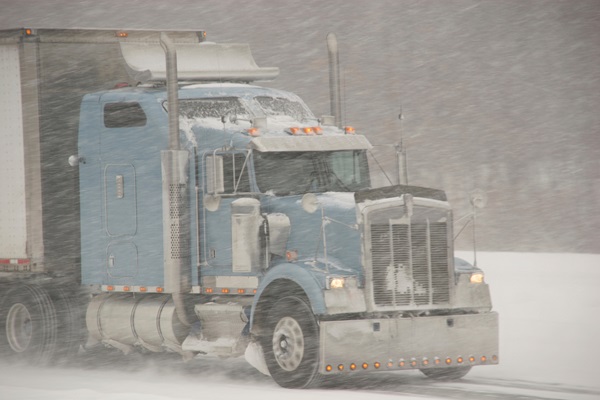
Indiana drivers know how bad winter weather driving can be in the Hoosier State. Whether it’s ice or snow, tractor-trailers and other large commercial trucks are often involved in serious truck accidents in winter that leave other drivers and passengers severely injured or worse.
When these winter truck accidents happen in Indiana, who’s legally responsible for paying for them? This might seem like a tricky question since some people might think that no one’s at fault, that it was simply bad weather or bad luck.
But that’s not how truck accidents work in Indiana. Truck drivers don’t get a free pass just because there’s snow or ice on the road at the time of a collision. Our Fort Wayne truck accident attorneys at Boughter Sinak, LLC, explain how the system works in Indiana.
How common are truck crashes involving snow and ice?
Many commercial truck accidents occur in bad weather, especially snow, ice, and other winter conditions. Specifically, roughly 1 out of 4 truck accidents nationwide involve snow, ice, and other winter weather-related incidents, according to the U.S. Department of Transportation.
As for Indiana, that’s roughly 1,400 truck accidents each year statewide due to snow, ice, or other hazardous winter weather conditions, according to accident data from the Indiana Department of Transportation.
All those truck accidents result in hundreds of injuries and fatalities. Specifically, winter weather truck accidents cause an estimated 116,000 injuries and 1,300 deaths nationwide each year, according to the U.S. Department of Transportation.
What is “liability” in a truck accident?
Liability is a legal term that refers to who’s legally responsible for paying for the accident. Indiana has an at-fault car insurance system. That means the at-fault party is responsible (liable) for paying for all accident-related expenses, which are referred to as “damages” in such legal cases.
So in terms of Indiana truck accidents, liability involves identifying who caused the accident and who’s ultimately responsible for paying for all financial losses sustained by all injury victims involved in the collision.
Does bad weather excuse fault in a truck accident?
No. This is a common mistake people make after a winter-related accident, including those involving commercial trucks. Just because it’s snowy or icy outside doesn’t mean that no one’s responsible for causing the collision.
Instead, just like any other Indiana truck accident, liability rules apply, and there’s an at-fault party who’s ultimately responsible for paying for the accident. In fact, federal law places a higher burden on truck drivers during winter storms.
Under 49 CFR § 392.14, commercial drivers are required to exercise “extreme caution” when hazardous conditions like snow or ice adversely affect visibility or traction. If the conditions become sufficiently dangerous, the law mandates that the driver stop the vehicle until it can be safely operated.
When a driver chooses to “push through” a Hoosier winter storm to meet a delivery deadline, they aren’t just battling the weather. They’re violating federal safety regulations.
Who’s liable in a truck accident involving snow or ice?
Depending on the circumstances of your Indiana truck accident during hazardous winter weather, there may be multiple at-fault parties responsible for paying for your accident, including:
- The driver operating the truck at the time of the crash, especially if they were speeding, distracted, tired, or impaired.
- A trucking company, especially if the company knowingly hired a reckless driver, failed to properly maintain the truck, or took other reckless actions.
- The company that loaded the truck, especially if it was not loaded properly, causing the contents to shift and the truck to rollover.
- The company responsible for maintaining the truck or its trailer, especially if safety protocols were not followed.
- Another driver, especially if you were involved in a multi-vehicle, chain-reaction accident.
- The state, city, or municipality responsible for maintaining the road, especially if no one plowed, salted, or sanded.
What evidence proves liability in winter weather truck crashes?
A wide range of evidence can be used to establish who was at fault for causing a winter weather-related truck collision in Indiana, including:
- Official Accident Report(s) For the Collision: There may be more than one since serious commercial truck accidents are often investigated by local, state, and federal officials.
- Video Footage of the Crash: This can include footage from traffic cameras, security cameras, and dashcams.
- Eyewitness Statements: If someone saw your collision, their statement could be a critical piece of evidence in support of your truck accident claim.
- Vehicle Debris: The point of impact on both vehicles, the location of accident debris, and other important physical evidence can tell a clear story about how the accident happened.
- Electronic Logging Device (ELD) and Black Box Data: We analyze the truck’s Engine Control Module (ECM) to determine whether the driver adjusted their speed to the conditions. If the truck was traveling at the 65 mph speed limit during a heavy snowstorm, that’s evidence of negligence.
- Ambient Temperature and Road Salt Logs: We cross-reference the exact time of the crash with local meteorological data and municipal salting records. If the road was properly treated but the driver still lost control, it points to driver error (such as “over-braking” on ice) rather than an unavoidable road condition.
Frequently Asked Questions: Indiana Winter Truck Accidents
The truck driver claims they “blacked out” because of a sudden whiteout. Is that a defense?
Insurance companies often try to use the “Sudden Emergency Doctrine.” However, in Indiana, a whiteout or a patch of “black ice” in February is considered a foreseeable hazard, not a sudden emergency. If a driver sees snow on the ground or temperatures below freezing, they are legally required to anticipate that the road will be slick.
Is the trucking company liable if the ice flew off the top of their trailer and hit me?
Yes. This is often referred to as a “falling ice” claim. Trucking companies are responsible for ensuring their vehicles are safe before they hit the road. If a driver fails to clear the “snow bridge” off the top of their trailer and that ice breaks loose, smashing your windshield or causing you to swerve, the company can be held liable for the resulting damages.
What if I was also sliding on the ice when the truck hit me?
Indiana follows a modified comparative fault system. As long as you are found to be 50% or less at fault, you can still recover compensation. Even if you were sliding, if a 80,000-pound rig was speeding or failed to maintain a safe following distance, the lion’s share of the liability likely rests with the professional driver who failed to account for the rig’s massive stopping distance.
How does “jackknifing” prove negligence in a snowstorm?
A jackknife accident usually happens because of a specific braking error. If a driver slams on the drive-axle brakes on a slick surface, the trailer’s momentum can swing it around. This is almost always the result of improper training or a panic reaction—both of which are forms of driver negligence that “bad weather” does not excuse.
Can a city be sued for not plowing the road before my truck accident?
While Indiana law allows for claims against government entities, “discretionary functions” like the timing of snow plowing are often protected by immunity. This makes it even more critical to focus on the truck driver’s choices. Regardless of whether the plow had arrived, the truck driver had a legal duty to adjust their driving to the road as it existed at that moment.
Hurt in a snow or ice truck accident in Indiana? Bad weather isn’t an excuse for negligence.
Snow and ice are a reality of Indiana winters, but they aren’t a “get out of jail free” card for negligent trucking companies. Federal law requires commercial drivers to exercise extreme caution or even pull over when conditions become hazardous.
Our experienced Indiana truck accident lawyers at Boughter Sinak, LLC, know how to find evidence that clearly shows what happened and who was at fault. That’s because we’ve been doing this work for years. Our case results demonstrate this, including one $12 million truck accident settlement.
Get an Indiana truck accident lawyer who knows how to get results. Contact Boughter Sinak, LLC, and schedule your free consultation. We work on a contingency fee basis. That means you pay nothing unless we win your case.
“I want to express my sincere gratitude of thanks for your efforts and the team at Boughter & Sinak. Having a fighter on my side removed all my stress, emotions (at least some), and anxiety contemplating all the parties involved in my accident case.” – Robert T., ⭐⭐⭐⭐⭐